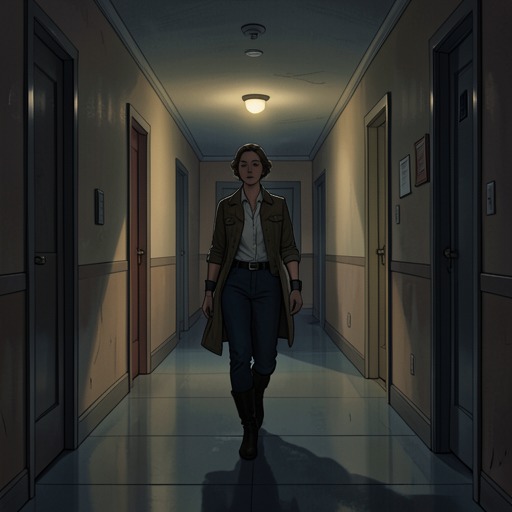
Lennie Walker
The Sky Is EverywhereLennie Walker is a seventeen-year-old whose bereavement unsettles not only her family life but also her understanding of what she wants and what she is capable of. Bailey’s death, their mother’s long absence, and Lennie’s own emotional upheaval converge in a story told close to her perceptions. Her path toward expression runs through a houseplant that seems to register her condition, a clarinet she has learned to hold back, and the difficult acts of speaking honestly to the people around her.
Identity and Introduction
At the opening, Bailey has been dead for four weeks, and Lennie’s mother has not contacted her for sixteen years. Gram worries about Lennie, but also about a particular houseplant whose leaves have developed black spots. For most of Lennie’s life, Gram has treated the plant as a reflection of Lennie’s emotional, spiritual, and physical well-being; Lennie has come to believe in that connection too. The plant makes private distress visible in the family home, turning a small change in its leaves into a reason to attend to Lennie’s condition.
Lennie’s return to school after a month away puts her grief on public display. She experiences the halls as opening around her and the conversations as falling quiet; the other students look at her with sympathy, as though her loss were visible. She describes the feeling as carrying Bailey’s death with her. That same day, attention also gathers around Joe Fontaine, a new student who arrived during her absence. The contrast does not make Lennie’s bereavement disappear: it places her conspicuous grief beside the school’s curiosity about someone new, showing how differently the two kinds of attention meet her.
Music and the Question of Ambition
Music gives Lennie both a means of expression and a measure of what she has been holding back. During an outdoor exercise, Mr. James urges the students to make music rather than simply concentrate on their instruments. He conducts the river, wind, and birds, and the players gradually join in, including Lennie. The resulting sound is untidy and collective rather than polished; for Lennie, taking part marks a moment of willingness. Back in the classroom, Mr. James gives her Marguerite St. Denis’s card and tells her to call at once. Lennie can recognize the expressive freedom she sees in Joe’s playing, yet measures herself against it: he has a daring she feels she lacks, and she remains in second chair.
Later, Lennie tells a young man that she deliberately failed the chair audition. The admission matters because she has not previously said it aloud to anyone, and speaking it brings relief. She explains that she did not want first chair or the solos. Playing with another person feels different from being alone in front of an audience; she tries to describe soloing as crossing the river from rock to rock in thick fog, without anyone beside her. Her image does not resolve the fear, and she retreats from explaining it. Still, the confession changes what her earlier musical position means: second chair was not simply a judgment of ability, since she had acted to avoid the responsibility of the solo.
Big challenges the idea that Bailey’s Juilliard ambition necessarily describes Lennie’s wishes. When Lennie insists that Bailey wanted to attend the school in New York and worked hard for it, Big asks whose dream it was. He recalls seeing Lennie as the one working hard, and imitates the posture of playing a clarinet. Marguerite’s praise and encouragement to pursue Juilliard return to Lennie’s thoughts. The exchange does not establish what choice Lennie will make, but it unsettles the assumption that her musical aspiration belonged to Bailey. It makes the distinction between the sisters’ dreams a question Lennie must face for herself.
Family, Loss, and Reconsideration
Lennie’s understanding of her family changes when she recognizes how Gram has kept their absent mother present in the household. Looking at Gram’s framed green figures, Lennie sees them as images of Paige Walker. She understands that Gram had protected Paige from blame for leaving her children, while quietly taking that blame upon herself. Lennie also remembers that she had blamed Gram for matters Gram could not control. The revelation revises Lennie’s earlier judgment: Gram’s care for the memory of Paige was not proof that the separation had been harmless, but evidence of a burden Gram had carried privately.
Lennie tells Gram that Paige’s departure and failure to return were Paige’s choice, not Gram’s fault. Gram exhales as if she has been holding her breath for sixteen years, then describes Lennie’s words as opening a window and letting Paige out. The exchange is consequential for both women. Lennie offers a clear account of responsibility where she had once joined in blaming Gram; Gram’s response suggests how long she has needed to hear it. The scene does not undo the mother’s absence. Instead, it changes the meaning of that absence inside the family, loosening the blame that had gathered around it.
Relationships and a Changed Voice
Lennie’s movement toward honesty also appears in her intimate relationship. After a period in which the two have not touched, she reassures the young man that she will not hurt him in the same way again and tells him that she wants a lasting life with him. His question makes his lingering hurt explicit, while his response conveys that he receives her promise. Their exchange is not presented as a simple return to what came before: vulnerability remains between them, and Lennie’s declaration carries the weight of what has already gone wrong. Her commitment suggests that she is trying to speak from a chosen future rather than merely react to grief.
Across these scenes, Lennie’s development is less a sudden cure than a succession of disclosures. She participates in music before she can explain her fear of performing alone; she admits that she sabotaged an audition; she revises her view of Gram’s responsibility; and she makes a promise to someone whose trust has been strained. The houseplant, the clarinet, and the family’s images of Paige each give shape to feelings that Lennie has struggled to state. Her movement is toward recognizing that grief and desire can occupy the same life, and that telling the truth about either one can change how she stands in relation to other people.